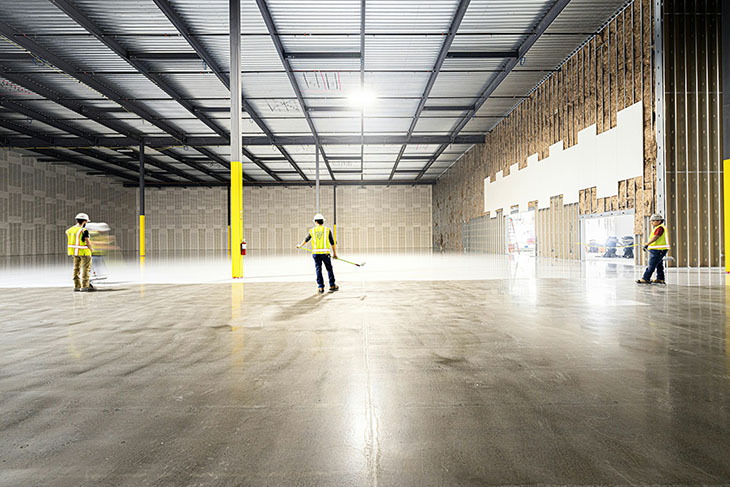
Industry 4.0 and 5.0 have necessitated the adoption of robotics and automated machinery like autonomous mobile robots (AMRs) and automated guided vehicles (AGVs). For these tools to operate as expected and yield benefits such as productivity enhancements and downtime reduction, their pathways need to be unobstructed. Floors also need to be flat, especially when operating at high speeds. Consider drafting a superflat warehouse floor to simplify operations.
Why Warehouses Need Superflat Flooring to Support AMRs
Only some concrete floors are flat enough to be considered for this designation, but the investment is worth it because it aids AMR traversal.
Ensures Navigation Accuracy and Safety of AMRs
AGVs and AMRs use sensors and cameras to follow their programmed pathways, as well as technologies like lidar to remain precise. These fixtures are delicate and need to remain operational at all times to prevent collisions with workers and other equipment. Preserving these sensitive components by minimizing vibrations and calibration errors is vital. Otherwise, safety incidents could occur, or autonomous vehicles could stop for no reason, perceiving a phantom obstacle.
Maximizes Operational Efficiency and Throughput
If an AMR operates on an uneven floor, it will lose speed and potentially veer off course. The advantage of using them is that they allow workers to carry heavy loads over long distances, helping them avoid injury and devote time to other high-value tasks. If AMRs change paths, they could cause even more downtime for warehouses and delay the return on investment.
One case study explored a 500,000-square-foot facility and its flooring redesign. After a hasty project approval, the floor flatness and aisle measurements did not meet the requirements for automated systems, leading to $3.8 million in remediation costs and $4.2 million in lost revenue from the scheduling delays.
Reduces Equipment Wear, Maintenance Costs and Downtime
A superflat warehouse floor helps maintain AMRs and AGVs by reducing pressure and stress on their components. One unexpected bump on the warehouse floor could lead to a misshapen joint or faulty bearing, reducing its lifespan and increasing unnecessary repair time and costs. In addition to mechanical components, electronics require even more care and incur extensive repair costs.
How to Get a Superflat Warehouse Floor
Ideally, warehouses create superflat floors during construction. In the design phase, engineers and geotechnical experts can observe the land and determine grading requirements. These surveys provide insights into the level of compaction and stabilization the ground needs to support a superflat floor. Additionally, designers should collaborate with AMR experts to determine the required floor flatness and levelness for their products.
After experts finalize blueprints, concrete specialists can mix, pour and cure the flooring. The ingredients must prevent shrinkage and cracking that could jeopardize smoothness. Supplementing it with synthetic fibers and sustainable options like slag and fly ash is often the go-to strategy for enhancing strength, alongside specialized equipment like laser screeds to ensure levelness.
Warehouses must understand the floor will be imperfect at this stage. Finally, teams will grind the surface and any surrounding flooring to make sure everything is homogeneous and flat. As demonstrated by the aforementioned case study, many warehouses choose a self-leveling overlay at this stage. Doing so is optional but helpful for preventing future, expensive concerns.
Why Maintenance Is Essential
Superflat floors need as much maintenance as the autonomous machinery operating on top of them. These are the primary ways to institute proactive and preventive care so the flooring considers the longevity of a warehouse’s AMRs:
- Audit sealing: Polished or epoxy concrete seals are the best shield against influences that lead to deterioration, such as moisture, salt and ultraviolet rays.
- Review joint integrity: Heavy machinery can strain slab connections, requiring workers to schedule inspections for wear and tear and apply filler as necessary.
- Clean surfaces: Removing debris is essential for protecting AMR sensors and other components. Using high-grade floor scrubbers and cleaning agents will keep floors and automation tools safe against buildup, chemicals and oils.
- Repair surface damage: AMRs and other warehouse activities can cause unintentional impacts and cracks. Patching damage with filler is essential, as well as employee training to prevent further accidents.
The AMR market could have a worth of $7.07 billion in the U.S. by 2032, but the value of these investments can only be lucrative if warehouse foundations support their seamless and uninhibited movement.
Driving Performance From the Ground Up
Automated warehouses are the future, creating environments that are safer and less stressful to work in. Workers are learning how to operate alongside these new workforce complements, but comprehensive buy-in may only occur if they feel comfortable with their workflows. The success of AMRs and AGVs begins on the ground. Implementing a superflat warehouse floor now could be disruptive, but it is the best step to take to support a tech-forward, innovative future of warehousing automation.