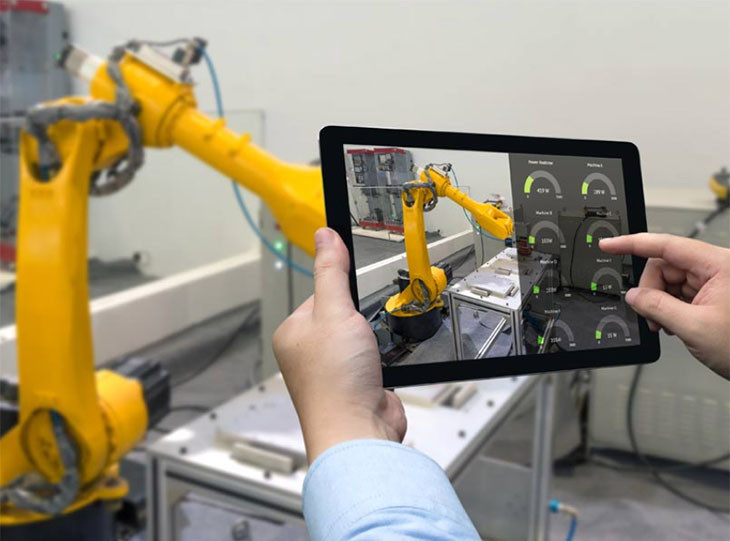
For years, manufacturing has organized its technology investments around the Digital Twin: build a virtual replica of the factory floor, run scenarios in software, reduce risk in the physical world. Billions flowed into simulation platforms and sensor networks. And yet, for many manufacturers, the promise stalled. The digital model stayed digital while the physical line kept running on rigid automation that could not adapt when conditions shifted.
That gap is closing, not because Digital Twins got better, but because a fundamentally different architecture has entered the conversation: Physical AI. These are systems that do not simply simulate the physical world but actively reason about it and act on it in real time, powered by a spatial computing stack combining foundation models, AI-generated software, and high-fidelity 3D sensing. Understanding how this stack works is now a practical requirement for any operations leader building a 2026 investment roadmap.
From Rule-Based to Agentic: Why Traditional Robots Hit a Wall
Conventional industrial robots are deterministic by design. They execute a fixed sequence of motions within tightly controlled tolerances. Change the part geometry, introduce a surface variation, or move a fixture by a few millimeters, and the program fails. Recovering requires reprogramming, which means downtime, engineering hours, and production delays.
Agentic robotics breaks this constraint. Rather than following a script, an agentic system perceives its environment through sensors, reasons about what it sees using a foundation model, and selects an appropriate action from a learned policy. If a component arrives at a slightly different orientation, the system adapts. If a weld surface shows unexpected variation, the system adjusts its approach rather than stopping the line.
This shift is already visible in deployment data. According to the International Federation of Robotics, global robot installations reached a record 590,000 units in 2023, with a growing share deployed in flexible, mixed-product environments that rigid programming cannot efficiently serve. The pressure to build systems that reason rather than just execute is coming directly from the complexity of modern production.
Collapsing the Sim-to-Real Gap with World Foundation Models
The sim-to-real gap has long been a stubborn obstacle in robotics deployment. Robots trained in simulation frequently underperform in the physical world because lighting shifts, material inconsistencies, and sensor noise create conditions that virtual environments could not faithfully replicate.
World foundation models are changing that. Trained on massive datasets of physical interaction and sensor data, these models generate synthetic training environments that closely mirror actual shop floor conditions. Manufacturers pre-training automation on these models report cost and risk reductions of up to 40 percent compared to traditional commissioning, with edge cases that once required weeks of live testing now stress-tested in software at a fraction of the cost.
The Spatial Intelligence Layer: Why 3D Perception Changes Everything
Traditional machine vision interprets the world through 2D images, a flat projection that works for simple inspection tasks but falls short on complex assemblies, freeform surfaces, and components where fit depends on precise spatial relationships.
Depth sensors and 3D point cloud processing provide a fundamentally different input. Instead of a pixel array, the system receives a dense geometric representation of every surface, capturing exact dimensions, surface normals, and spatial relationships between components. An AI agent working with this data can evaluate a part in full geometric context, catching defects and misalignments that would be invisible or ambiguous in a 2D image.
The implications for quality control are significant. Research published in manufacturing process journals has documented that 3D inspection systems consistently outperform 2D counterparts on complex geometry, particularly in applications involving curved surfaces, threaded features, and assembly verification where positional accuracy is critical.
As foundation models become capable of processing 3D point clouds natively, spatial intelligence is becoming the core perception layer for Physical AI systems. The geometry of the physical world is no longer abstracted away. It is the primary input.
The Digital Thread: Erasing the Handoff Delay
In most manufacturing organizations, engineering and production run on different timescales and disconnected data systems. Change orders travel through approval workflows and manual translations before reaching the floor, often days or weeks after the design decision was made. That lag is a primary driver of schedule overrun and rework cost.
Physical AI enables a Digital Thread that eliminates this delay. When an AI agent detects a deviation from specification, it feeds back into the engineering model in near real time. When a change is approved, it propagates to production without manual handoff. There is one continuous data stream.
The operational impact of this architecture is measurable. The Manufacturing Leadership Council has found that manufacturers with mature Digital Thread implementations report time-to-market improvements of 20 to 30 percent compared to peers operating with disconnected engineering and production systems.
A Practical Frame for 2026 Investment Decisions
Physical AI is not a single product or platform. It is an architectural shift that requires evaluating your current stack across three dimensions: perception (are your sensors capturing spatial data or only 2D imagery?), reasoning (are your automation systems rule-based or capable of agentic decision-making?), and continuity (is there a live connection between your engineering and production data, or are they separated by manual processes?).
The manufacturers who will gain competitive ground in the next two to three years are not necessarily those with the largest automation budgets. They are the ones who recognize that the constraint is no longer hardware. The constraint is intelligence, and intelligence is now available at a scale and cost that makes deployment practical across a wide range of production environments.

Dijam Panigrahi is Co-founder and COO of GridRaster, a spatial computing platform for industrial enterprises. For more information visit www.gridraster.com.