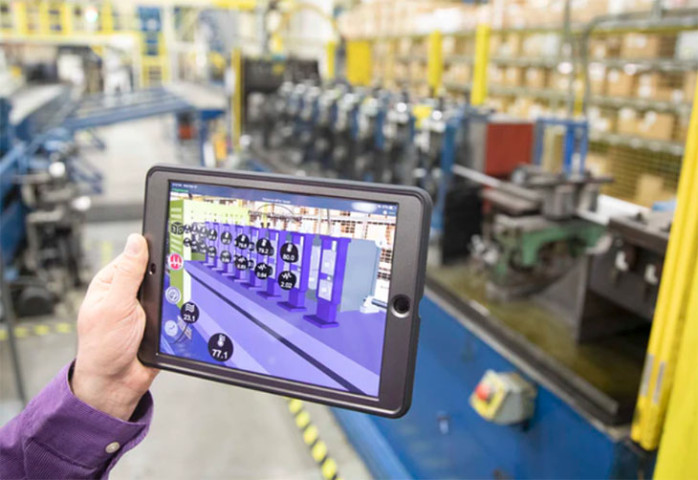
Smart factories have never been more capable on paper. Artificial intelligence, spatial computing, autonomous robotics, and real-time data processing have converged into what industry observers are calling the era of physical AI. Yet despite billions in investment and years of experimentation, a striking number of manufacturers are still not realizing the full operational value of these technologies.
According to a 2025 State of AI in Manufacturing Survey, more than 77% of manufacturers have implemented AI to some degree, yet 56% remain unsure whether their existing systems are ready for full integration. The gap between adoption and value is not a technology problem. It is an implementation problem.
The Promise of Spatial AI and Agentic Systems
Spatial AI refers to the ability of machines to perceive, understand, and act within three-dimensional physical environments in real time. When combined with agentic AI, which describes systems that pursue goals autonomously across multi-step workflows, the result is a factory floor that can theoretically monitor itself, diagnose its own inefficiencies, coordinate logistics, and adapt production in response to changing conditions without waiting for human intervention.
This is a meaningful evolution from earlier automation paradigms. Traditional industrial systems followed rigid, pre-programmed rules. Spatial and agentic AI introduce contextual reasoning, enabling machines to respond to ambiguity rather than simply execute fixed instructions. The factory, in this model, becomes less of a static machine and more of a dynamic, self-correcting system.
The market reflects this momentum. Industry analysis shows AI can lower manufacturing maintenance costs by 25 to 40%, and 78% of production facilities using AI reported measurable waste reduction. The operational case is clear. The execution, however, remains uneven.
The Data Problem Beneath the Surface
The most persistent obstacle to realizing smart factory potential is not a lack of sensors or algorithms. It is the quality and structure of the data those systems depend on. Raw data collected from the factory floor is rarely ready to drive reliable decisions. It must be standardized, timestamped, and mapped to real-world operational events before it can be trusted.
When data contextualization is poor, AI systems generate outputs that are technically accurate but operationally misleading. A predictive maintenance model fed inconsistent sensor data may flag false positives that disrupt production schedules, or miss early failure signals entirely. The model is not the problem. The data pipeline feeding it is.
Most manufacturers still operate with fragmented data ecosystems, as noted in recent industry reporting, including legacy MES and SCADA systems, siloed PLC data, and inconsistent sensor quality. Until these ecosystems are unified, AI will continue to produce insights that reflect the gaps in the data rather than the reality of the production environment.
Building a Single Source of Truth
The concept of a unified data layer, often described as a single source of truth, is foundational to effective smart factory operations. When production data, quality metrics, and logistics information live in separate systems that do not communicate in real time, each function is effectively operating with an incomplete picture. AI agents attempting to optimize across these functions will inevitably make decisions that are locally rational but globally inefficient.
Moving toward a unified data architecture requires more than technology investment. It demands organizational commitment to retiring or integrating legacy systems, establishing shared data standards across departments, and maintaining those standards over time.
A Deloitte survey of 600 manufacturing executives found that 41% of respondents plan to prioritize factory automation hardware investment in the next two years, with sensors and vision systems close behind. These investments will only deliver value if the underlying data infrastructure is prepared to handle them.
Designing for Disruption, Not Just Ideal Conditions
A recurring failure mode in smart factory deployments is designing AI systems that perform well under normal operating conditions but break down when reality diverges from expectations. Engineers often refer to this as the happy path problem. An autonomous system that navigates routine production sequences flawlessly may create hidden bottlenecks when supply disruptions, equipment anomalies, or workforce changes introduce variability.
Robust exception handling is therefore not a secondary feature. It is a core design requirement. Systems must be built to recognize when they are operating outside familiar parameters, communicate that uncertainty clearly, and escalate appropriately rather than defaulting to best guesses.
Human-in-the-Loop Governance as a Competitive Advantage
The phrase human-in-the-loop is sometimes misread as a concession to caution, a reluctant acknowledgment that AI is not yet ready to operate fully independently. In practice, it is better understood as a deliberate architectural choice that improves both safety and performance.
This view is supported by manufacturer preferences. The same 2025 manufacturing survey found that 53% of manufacturing specialists prefer working with collaborative AI agents that support human workflows rather than replace them entirely. The most effective smart factory implementations are those where AI handles high-frequency, data-intensive decisions within defined parameters, and humans retain authority over consequential, novel, or high-stakes situations.
Establishing explicit escalation and approval frameworks is what makes this division of responsibility operational. Without clear protocols defining when an AI agent should proceed, pause, or alert a human operator, organizations face two failure modes: systems that escalate too aggressively and defeat the efficiency gains of automation, or systems that escalate too rarely and allow errors to compound unchecked.
What Disciplined Implementation Looks Like
Manufacturing leaders who are seeing consistent returns from spatial and agentic AI investments tend to share a common approach. They treat data infrastructure as a prerequisite, not an afterthought. They pilot in constrained environments before scaling, which allows exception handling to be tested under realistic conditions. They involve operations teams in defining escalation protocols rather than delegating that design entirely to technology vendors. And they measure outcomes at the system level, not just within individual functions.

Dijam Panigrahi is Co-founder and COO of GridRaster, a spatial computing platform for industrial enterprises and manufacturers. For more information visit www.gridraster.com.