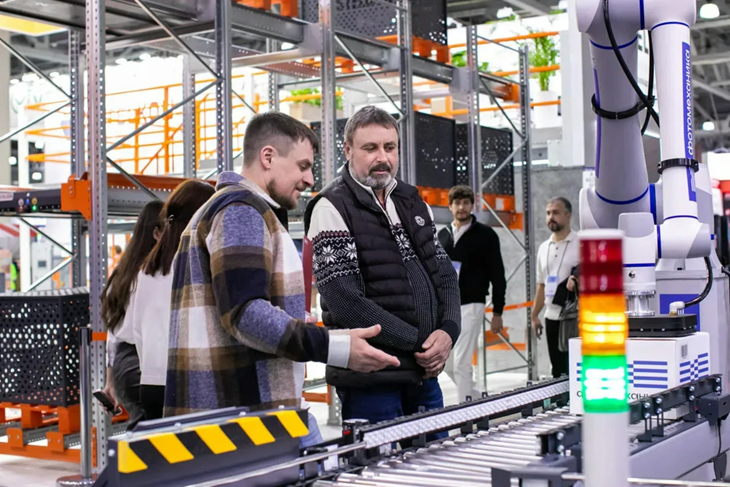
Manufacturing automation has been a transition of necessity. Most facilities need to output higher volumes with faster lead times while working with limited staffing resources. Smart factories could mitigate concerns with this rapid scaling, but this transition has led many workers to anticipate the trajectory of their careers.
The most effective and forward-thinking organizations are embedding automation upskilling into their digital transformations, while maintaining employee-first values to become more competitive and adaptable. These evolutions are the cornerstone of progress.
The Rise of the Cobot Operator
The makeup of manufacturing workforces is starting to look different. Cobots have entered the floor, assisting employees with everything from picking and placing to acquiring inventory. They keep people out of dangerous machinery and away from boring, redundant tasks.
The influx of robotic aids enables employees to learn how to use and maintain these machines. At the same time, they can embrace other job opportunities that are more high-value and fulfilling compared to repetitive, manual labor.
In the U.S., the manufacturing sector has hit a six-year low for employment, even though orders have hit a four-year high. Supplementation is necessary while keeping the human-in-the-loop element. Cobots offer workforces the opportunity to eliminate overwork and stress while accomplishing more.
These workers are augmenting their jobs rather than losing them, leading to personal growth and skill development they would not have achieved without manufacturing automation. They could embrace skills like:
- User interface design
- Process optimization
- Basic engineering
- Robotics maintenance
The Data-Driven Decision-Maker
Everything in a smart factory is based on data, powered by innovations like the Industrial Internet of Things (IIoT). They inform employees how to predict maintenance needs for conveyor belts and suggest ways to improve air quality through environmental monitoring. Their range is expansive, and the workforce has a chance to learn how to read, visualize and apply the insights they gain from these numbers.
As the team’s mindset shifts from reactive to proactive and data-driven decision-making, they have more agency over their tasks. They know how to prioritize effectively and can back up their choices with data.
Manufacturing intelligence specialists and analysts are core pieces of any team now, as they use data science skills to get a more specific picture of the company’s proprietary information and anticipated performance. This eliminates the need for manual reporting and streamlines everything from maintenance scheduling to waste reduction.
Workers can gather information from all autonomous systems to respond to situations dynamically, such as:
- Artificial intelligence
- Data analysis and software
- Sensors
The demand for software-focused talent is clear, as labor statistics indicate a continued rise in related roles through 2034. More people will need to know how to test, audit and analyze automation machinery for quality and security, and they can only do so if they know how to use data-driven insights.
The Digital Twin Architect
Digital twins are simulated representations of manufacturing processes. They can show the efficacy of hundreds of thousands of square feet of lighting systems, or depict the pathways people take to deliver pallets between departments. This software and hardware can suggest productivity enhancements and process discoveries, but it is the team’s job to discern what is useful and viable.
This technology creates the need for digital twin engineers and experts in virtual processing. They could learn to configure simulations, optimizing them to have large-scale impacts on the facility. These skills are also essential for research, as universities conduct experiments and tests to perfect these technologies.
The Augmented Worker
Augmented reality (AR) is another way to incorporate data and simulations into manufacturing. It is effective in scenarios like training, where workers can be guided through potentially dangerous tasks in a more realistic environment.
They can learn to change parts on a machine that only needs it once every two years, and they can witness the importance of safety without being put in danger. Employees get real-time feedback instead of relying on the limited information in a paper manual.
AR-focused training specialists and augmented workers are in demand. The best teachers will create teams that consistently foster a safe working environment and reliable, quality output. Additionally, using AR to upskill employees can save corporations thousands of dollars in training and onboarding costs. This enables them to allocate more resources to enrich their existing staff.
The Advanced Robotics and Maintenance Specialist
Data will let employees know the best time to fix a machine, rather than relying on conventional manufacturer-recommended schedules. Sometimes, this can lead to overmaintenance, which wastes money and parts.
Sensor-based technologies could inform teams and train employees to be more proactive in their repair timelines. Instead of responding to a breakdown, upskilled teams can continually optimize based on incoming information.
This visibility enables workers to learn about the machinery more intimately. They will spend less time responding to emergency downtime and more energy on diving deep into the equipment’s components and mechanics.
Eventually, this could build a crew of experienced robotics technicians or mechatronic engineers, who install, program, repair and troubleshoot automation machinery. More than 542,000 new robots were installed in manufacturing environments in 2024, indicating a need for skilled workers to oversee their operations.
The Automated Logistics and Supply Chain Optimizer
While automating the floor increases throughput, incorporating these technologies into logistics is equally beneficial for staff and productivity. Automated warehouses, mobile robots and logistics platforms are the focal points of advanced and efficient operations.
Workers in these domains learn skills like automation engineering for picking machinery, logistics data analysis from warehouse software and more. The average square footage of the modern warehouse is increasing rapidly, meaning employees have to cover more ground than ever before. The accuracy and transparency of data will help them reduce human error and maintain reliable inventory, even as volume increases.
Automation Upskilling for Better Workforces
When executed correctly, the transition to manufacturing automation can be an employee-focused effort. On the surface, it may seem like the workforce is becoming dominated by robotics and sensors. In reality, people have been issued more stimulating and valuable work, learning new skills that make them competitive in the next era of industry.
Thought leaders in the sector see these opportunities as part of their investment in the technology, making it valuable for both the company’s bottom line and employees’ well-being.
Lou Farrell
Lou is the senior editor of industrial manufacturing at Revolutionized Magazine, specializing in writing about the impacts of technological advancements on the modern world of production. For over five years, he has pursued his passion for writing by providing insights into automated industry processes and sustainable manufacturing.