











Achieving extreme thickness-to-span ratios in industrial enclosures presents a mechanical challenge. Designers must balance rigidity and thermal stability without overbuilding or introducing additional assembly complexity. Achieving ambitious thickness ratios with a one-piece aluminum frame often results in unacceptable flexing or costly reinforcements that negate the original design intent.
Hantek's latest solution challenges that limit. Its innovation delivers strength and stability without the need for internal ribs or multi-part fastened construction. This monolithic chassis is a functional, scalable platform built for real-world use. In doing so, Hantek has set a new standard for enclosure performance, proving that precision engineering and simplified structure can coexist at extreme ratios.
The Engineering Problem Behind the “Impossible” Ratio
Traditional multi-panel chassis designs often reach a limit in terms of stiffness and thermal stability. Each panel junction introduces potential misalignment, and fasteners or adhesives become mechanical weak points that concentrate stress. At lower thickness ratios, these seams amplify vibration and flex under load, which degrades performance and shortens component life. Attempts to solve this through incremental material upgrades, such as stronger alloys and better fasteners, only address the symptoms.
Compounding the issue, processes like thermal debinding introduce their own mechanical risks. During manufacturing, metal parts exposed to uneven heating often suffer from distortion and porosity, which can severely weaken structural performance. These limitations demonstrate why legacy designs, even when refined, may struggle to overcome the mechanical barriers to achieving high performance in thin-walled enclosures.
Why a One-Piece Aluminum Frame Changes the Equation
Unlike conventional designs that rely on bolted or welded panels, a monolithic chassis eliminates the discontinuities that often compromise structural performance. Hantek’s one-piece aluminum frame embodies this approach, delivering high rigidity and reduced complexity in a unified form.
Compared to assembled enclosures, a monolithic chassis offers uninterrupted load paths that distribute stress more evenly across the structure. Removing fasteners and seams prevents localized stress buildup and minimizes the risk of distortion under thermal load. This continuity enhances mechanical durability and improves long-term reliability in harsh operating conditions. For high-performance industrial systems, the monolithic approach marks a leap forward in enclosure engineering.
Material Selection and Metallurgical Trade-Offs
Alloy selection is critical to balancing mechanical performance and manufacturability, especially when pushing structural limits. For Hantek’s monolithic chassis, choosing an aluminum alloy offered high yield strength and excellent machinability, which enables precise cuts and thin-wall stability without compromising integrity. Aluminum’s low density and natural resistance to corrosion also make it ideal in sectors like transportation and construction, where weight and durability matter.
Under thin-wall machining conditions, grain structure behavior becomes especially important. If the grain orientation or hardness varies too much, it can lead to uneven tool pressure or surface tearing. Aluminum alloys with fine, uniform grains perform more predictably, allowing for aggressive material removal while maintaining wall uniformity. This behavior directly influenced the achievable thickness limits, as only materials with predictable machining characteristics could hold tolerances at the extreme 12:1 ratio.
Precision Manufacturing at Extreme Tolerances
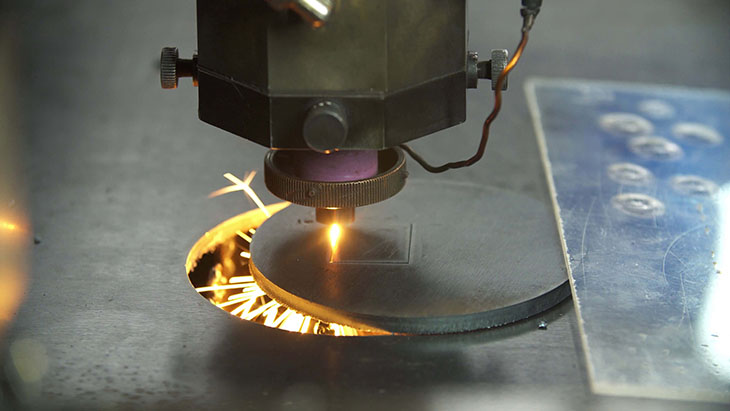
Machining a part as large and thin as Hantek’s one-piece aluminum frame, covering roughly 45 square feet with wall thicknesses from 0.16 to 1.97 inches, requires extreme precision and planning. Traditional cutting strategies can easily introduce chatter or uneven material removal. To address these risks, engineers rely on advanced toolpath optimization, carefully sequencing cuts to maintain structural integrity during each phase.
Thermal effects pose another major challenge. As the frame is machined, friction generates heat that can subtly expand material, introducing hidden distortions. To prevent this, manufacturers use real-time thermal compensation, which adjusts tool movements based on temperature feedback. Residual stress management is equally important. Aggressive roughing must be followed by measured, staged finishing cuts to release internal stresses gradually. These techniques help create thin-walled enclosures at scale without compromising precision or mechanical performance.
Thermal and EMI Implications of a One-Piece Aluminum Frame
Reduced seams in a chassis design significantly alter how heat flows through the structure. This improves thermal management in environments where localized hot spots could affect sensitive electronics or mechanical components. However, aluminum begins to lose strength above 400° Fahrenheit, which restricts its use to low- and moderate-temperature applications. While it excels in thermal conductivity, designers must account for this temperature ceiling when deploying enclosures near power electronics or heat-intensive equipment.
The monolithic frame offers inherent electromagnetic interference (EMI) shielding advantages. A seamless conductive surface blocks interference more effectively than one with mechanical joints or dissimilar materials. The trade-off comes with thinner wall sections. They may amplify vibration, reduce acoustic isolation or increase susceptibility to denting under impact. Balancing those variables maintains structural and electromagnetic performance in high-stakes industrial settings.
Industrial Applications That Benefit Most
Many industrial applications are constrained by enclosure designs that can't balance thin walls with wide surface spans. As chassis get larger, traditional assemblies struggle to maintain stiffness and resist vibration without adding weight or internal bracing. This becomes a limiting factor in systems like industrial automation platforms and ruggedized electronics, where heat management and vibration control are critical to performance.
Hantek’s monolithic design sidesteps these limits. By using a one-piece aluminum chassis, it delivers stability and mechanical strength across a broad area. This approach is especially valuable in high-performance environments, much like carbon-fiber composites, which continue to gain ground in luxury automotive sectors despite costing many times more than steel. For users focused on reliability and weight reduction, the performance benefits of this architecture outweigh the added complexity or material expense.
What This Means for Future Industrial Design
The monolithic chassis represents a shift in enclosure engineering. While broader adoption must account for scalability limits and the cost of precision machining, the benefits in structural performance and integration often outweigh the barriers in high-value systems. Hantek’s achievement of a 12:1 ratio with a one-piece aluminum frame resets industry expectations, proving that thin, large-scale enclosures can now meet demanding mechanical and thermal requirements without compromise.